
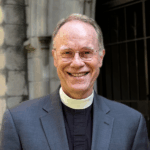
Sermon Transcript
St. Paul declared in Athens: “The God who made the world and everything in it, he who is Lord of heaven and earth, does not live in shrines made by human hands, nor is he served by human hands, as though he needed anything, since he gives to all mortals life and breath and all things.” (Acts 17:24-25)
Today’s reading from the Book of Acts reminds me of a strange but true, life and death encounter I once experienced. My parents had recently moved into a new house, and my two brothers and I were there to be helpful. The three of us were in our 20s at the time. If memory serves, it was May. It could have been Mother’s Day. What better way to lend a hand than to get a roaring fire going in the fireplace in honor of Mom? It had to be done. To check the flue, I reached up and took hold of the sooty lever, but could only open it an inch or two. Something was blocking it. Undaunted, I inserted a fire poker and pushed up on the obstruction until I could open the flue all the way. Then I began to pull down what was blocking the chute.
What came down the chimney? Let me tell you: it wasn’t Santa Claus. It was a tangle of sticks and leaves that landed in the fireplace with a plume of ash. On top of the pile, which apparently was a squirrel’s nest, was the squirrel itself. One of my brothers thought he saw the squirrel move, and shouted – most unhelpfully, I might add – “LOOK OUT! IT’S ALIVE!” Let the language that followed be imagined rather than repeated. Startled, we all backed away, but the squirrel did not move. Carefully, I reached over with the fire poker to give it a nudge. Then another poke. It was as stiff as a board. It was not alive. The squirrel had not moved. It had merely bounced. The squirrel was dead.
The saga of the squirrel brings me back to today’s reading from the Acts of the Apostles (17:22-31). At one point in his missionary travels St. Paul had a few free days to enjoy in the city of Athens while he waited for Silas and Timothy to join him. What would he do? Well, if you read the passage just prior to what we heard today, at first it appears that Paul played the tourist. He poked around the city and took in the Acropolis and other architectural wonders. Eventually something began to gall him. Everywhere he looked was a glorious temple to yet another god from the pantheon of Greek mythology. It was said in those days that Athens was so full of idols that it was easier to meet a god than it was a person. Today we look at the ruins of these temples as interesting examples of architecture and culture. But Paul saw them in full use, with people bowing down and offering sacrifices to statues. They were praying to gold, silver, and stone idols as if these things made with human hands had life in them.
The sight sickened Paul. So what he did was argue with anyone who would give him a hearing: devout Jews in the synagogues, pagans in the marketplace, and even the Epicurean and Stoic philosophers who came out to investigate the newly arrived “babbler” of “foreign divinities,” as they called him. Apparently the philosophers were intrigued by what they heard, so they invited Paul to come back with them and address the Areopagus. In the time of Paul, the Areopagus, or Mars Hill, was a place as well as a council of city leaders and thinkers. What they believed specifically about God is a topic too large for our purposes today. To be sure, a few might have been pagans who took seriously the gods and goddesses of Mt. Olympus. But the philosophers were more likely to be deists, who believed that God was far off and uninvolved in human affairs. Or they were pantheists, who believed that God and nature were inseparable. God didn’t make the world, God was the world.
In any case, Paul proved himself adept at conversing with all the belief systems at the same time. What we heard today is most likely a digest of a much longer address. He opened by talking about his poking around the city, and said that of all the objects of worship and temples he saw, only one of them met the test of life. The rest were stiff as a board. Paul had found one altar with the inscription, “To an unknown god.” He went on to say, “What therefore you worship as unknown, this I proclaim to you.” From there Paul spoke of the God who made the world but is not the world, who needs nothing from his creatures but gives everything to them, including life and breath.
Paul knew how to be persuasive. Where the philosophers were right he affirmed them. Where he thought they were in error he challenged them. What is more, Paul declared that God’s leniency with their ignorance was coming to an end. God wants to be known, and therefore raised Jesus from the dead to catch the world’s attention. I recently read a definition of God that caught my attention: God is whoever raised Jesus from the dead, having before raised Israel from Egypt.[i] This is the God Paul proclaimed to the Areopagus. If we read just beyond today’s passage we learn the effect that Paul’s preaching had on the philosophers: some sneered, some wanted to hear more later on, and some went with him.
Even still, Paul’s audacity in preaching to the Athenian philosophers might raise questions in your mind, if not objections. First, who did Paul think he was: going into Athens full of judgment, even to the point of declaring their idols to be empty and dead? Secondly, Paul promised an immanent day when the risen Jesus would judge the world in righteousness. To many it seems that we are no closer to such a day now than Paul was then. They wonder what Paul would have thought had he known we’d still be waiting in the year 2026? So much for the urgency of his call to repentance. Therefore, say the cynics, all of religion is just a matter of arguing over whose imaginary friend is bigger and better than whose. Tolerance and cultural appreciation are the better way to go. Paul should have just enjoyed touring Athens, taking in the art and architecture, and keeping his mouth shut.
What was driving the urgency of Paul’s message? Why was he insistent that they repent of their idolatry, be those idols things made with hands or ideas cooked up in their minds? The answer is that we tend to become what we worship. I recall something I read by one of my predecessors, Walter Russell Bowie, who was the Rector of Grace Church from 1923 to 1939. Earlier in his ministry, during World War One, Bowie had taken a leave from his parish in Richmond, VA, to be a Red Cross chaplain at a field hospital in France. He had heard the message that this would be “the war to end all wars,” and “the war to make the world safe for democracy.” He wanted to do his part, as did many of his generation. But once there the death and destruction he witnessed caused him to conclude that war brought only that: death and destruction. He determined that never again would he speak a positive word about war. It was a dead, death-dealing philosophy.
In a sermon[ii] he preached from this pulpit in 1932, Bowie took aim at a monument here in New York City: the great statue of General William Tecumseh Sherman near the Plaza Hotel. First, he praised the artistic merits of the piece by the sculptor, Augustus Saint-Gaudens, calling it “one of the most superb things on this continent.” But then he went on to condemn what the statue symbolized. It “illustrates the false enslavement of our imagination from which we must be delivered,” he said. Bowie thought that the statue, depicting an angel of God leading Sherman on his march to the sea, glorified war, when Sherman himself had said, “War is hell.” He was concerned that if we glorify war we become warriors. In our own day, we might view with alarm the recent rumblings to change the name of the Department of Defense to the Department of War. What is the purpose of the military? Is it to defend our shores and the rule of law around the world? Or is it to make war? Is it defense or offense?
My point here is to illustrate a truth about worship and human nature. We do what we do because we worship what and whom we worship. We become what we worship. What upset Bowie about the statue of Sherman is why Paul felt the urgency to rail against the Athenian idols. Idols do not deliver the light and life that God wants to share with all people. You heard that right: far from being content to remain unknown, far from leaving us to stumble around in the darkness, God wants to share his divine life with all people, in all times and in all places. God is love. The author of today’s Epistle, 1st Peter (3:13-22), even alludes to Christ’s going to the spirits of those from times long past, so that they too could be brought to God. But when we worship what is not God – when our greatest passion is for something that is not God – we veer from our created destiny, which is to live completely into the image of God.
What does Jesus have to do with all this? He is the image of the invisible God. We worship him because we believe that in him all the fullness of God was pleased to dwell. We worship Jesus in order to grow into the full stature of Christ. As Jesus himself said to his disciples, “If you love me, you will keep my commandments. And I will ask the Father, and he will give you another Advocate, to be with you forever. This is the Spirit of truth.”
At the Areopagus, St. Paul challenged all of his listeners to apply the test of life to their idols and philosophies. His challenge would be the same for us. It is to examine our lives for those things, those ideas, those passions that we idolize, that we love more than God. It is to poke at them and see if they move. You know the usual suspects: money, lifestyle, prestige. Are they alive? Do they bring life? The sad truth is, we can make an idol out of anything. Even good and potentially holy causes can begin to compete for first place in our lives, and deafen our ears to the one who stands at the door and knocks. Thus the urgent call to answer the door, repent of our idols, and get the worship right. When we crown Jesus with all renown, then the Spirit of truth comes in to merge with our spirits. Then we might have life, and have it abundantly.
Concerning the surprising experience of encountering the true and living God, C.S. Lewis wrote the following:
You have had a shock like that before, in connection with smaller matters – when the line pulls at your hand, when something breathes beside you in the darkness. So here; the shock comes at the precise moment when the thrill of life is communicated to us along the clue we have been following. It is always shocking to meet life where we thought we were alone. “Look out!” we cry, “it’s alive.” … There comes a moment when the children who have been playing at burglars hush suddenly: was that a real footstep in the hall? There comes a moment when people who have been dabbling in religion suddenly draw back. Supposing we really found Him? We never meant it to come to that! Worse still, supposing He had found us?[iii]
St. Paul declared to the Athenians that it really has come to that. “The God who made the world and everything in it, he who is Lord of heaven and earth … who gives to all mortals life and breath and all things,” – this God has indeed found us. Remember: God is whoever raised Jesus from the dead, having before raised Israel from Egypt. This is the hope within us. This I proclaim to you: Look out: Christ is alive!
+
[i] Robert W. Jenson, Systematic Theology: The Triune God. Oxford University Press, 1997, p. 63.
[ii] Walter Russell Bowie, “Our Changing Conception of War,” May 29, 1932.
[iii] C.S. Lewis, Miracles. Macmillan, 1965, p. 96-97.
The Weekly Epistle
Friday newsletter with parish updates and a word from our Rector.
Read The Weekly EpistleMusic List
May 10, 2026
The Combined Choirs
Hymns 379, God is love, let heaven adore him…….ABBOT’S LEIGH
…..292, O Jesus, crowned with all renown…….KINGSFOLD
…..579, Almighty Father, strong to save…….MELITA
Pascha nostrum…….Anglican Chant (Goss)
Anthem, Hallelujah! from MESSIAH…….George Frideric Handel (1685 – 1759)
Offertory Anthem, How lovely is thy dwelling place…….Johannes Brahms (1833-1897)
Prelude, Toccata in e…….Johann Pachelbel (1653-1706)
…..Ciacona in e, BuxWV 160…….Dietrich Buxtehude (c. 1637-1707)
Postlude, Prelude, Fugue and Chaconne in C, BuxWv 137…….Dietrich Buxtehude
Get Connected
Subscribe to our contact list to receive the latest updates, inspiring stories, and invitations to community events.