
Sermon
The Things That Are God’s
October 18, 2026
The Twenty-First Sunday after Pentecost
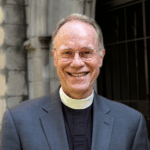
Sermon Transcript
Jesus said, “Give therefore to the emperor the things that are the emperor’s, and to God the things that are God’s.” (Matthew 22:21)
A story is told of two feuding families in Louisiana. For generations they had lived next to each other in great southern estates, and for generations not a kind word had passed between them. It seems that the source of the tension was a dispute over which family owned a large parcel of land between the estates. The first family claimed it was theirs because during a Civil War battle, when everyone else had fled, their great, great, great grandfather had fought against the invading Yankees and given his life defending his home – right over there by that stretch of trees. The second family said it was theirs because they had farmed cotton on it since before the Civil War, and while they were grateful to the local war hero, the land was never his to defend.
The feud went on until no one could stand it any longer. So both families finally agreed to hire a law firm to do a title search and determine the true owner of the property. Strangely, the only title the firm could find belonged to the United States of America, which had bought the property from France in 1803 as part of the Louisiana Purchase. All very interesting, indeed, but it didn’t settle anything between the feuding families. So they commissioned the law firm to dig further. Finally, when the firm could do no more, they sent the following note to the head of each family:
Dear Sirs: Please be advised that in the year 1803 the United States of America acquired the territory of Louisiana from the Republic of France, by purchase. The Republic of France, in turn, acquired the title from the Spanish Crown, by conquest; the Spanish Crown having obtained it by virtue of the discoveries of one Christopher Columbus, who had been authorized to undertake his voyage by Isabella, Queen of Spain. Isabella obtained sanction for the journey from the Pope. The Pope derived authority by his being the Vicar of Christ. Christ is the Son and Heir of Almighty God. And God made Louisiana.
What is the point of this little story? Good fences make good neighbors? No. The point is this: what we think belongs to us belongs instead to God. God owns all of it.
In today’s reading from the Gospel of Matthew we’ve heard an incident that highlights the growing hostility of the Pharisees towards Jesus. In first-century Palestine, the Pharisees were the Jewish religious authorities who interpreted the Law of Moses and translated precisely how people should go about obeying it. Jesus, the itinerate rabbi, was preaching a new and radical way to follow the Law and fulfill it. The way of Jesus clashed with the way of the Pharisees, so these institutional clerics became ever more determined to silence the rival voice. They wanted to entangle Jesus in his talk, and either get him trouble with the Roman authorities, or get him in trouble with the Jewish people. So the Pharisees crafted what they imagined would be the perfect, inescapable lose-lose question for Jesus: “Is it lawful to pay taxes to the emperor, or not?” If Jesus said no, he would arouse the ire of Rome and be arrested. If he said yes, he would arouse the ire of the Jewish people and possibly be stoned as a blasphemer.
You see, the Jews hated paying taxes to the Romans, whom they considered to be the illegal occupiers of the land that God had leased to them. The emperor didn’t own the land, God did. The Jews were the rightful tenants, not the Romans. Thus, paying taxes to the emperor was a form of idolatry, and contrary to the Law of Moses. The Pharisees were insufferably pleased with their little scheme. Either way Jesus would lose. But Jesus did not lose. He said, “Give, therefore, to the emperor the things that are the emperor’s, and to God the things that are God’s.” Many commentators say that the genius of Jesus was in the way he completely sidestepped the hateful scheme of the Pharisees. It’s true, and we can admire how Jesus befuddled his adversaries. But surely the passage has more meat to it than clever conflict avoidance.
What did Jesus really think? Two adjectives might best describe what Jesus thought of the Pharisees’ question. Number-one, it was irrelevant. Number-two, it was hypocritical. The question was utterly irrelevant because paying taxes to the emperor was simply the economic law of the land. Counseling ordinary citizens to disobey Roman law would only set them on the road to disaster. But the question was irrelevant on a deeper, theological level. It struck at the age-old, yet misguided desire to put up a fence between spirit and substance, to detach mystery from matter, to disconnect God from money. You see, within the Judaism of Jesus’ day, certain groups adamantly believed that truly spiritual people should shun the material order. Truly spiritual people should avoid money, especially unclean Roman coins that had the emperor’s idolatrous image and claims stamped on them. God and money don’t mix. Mystery and matter cannot dwell together. But the false dichotomy between spirit and substance was then, and remains today, irrelevant. We who are dwellers in time and space have no choice but to deal with flesh and blood, bricks and mortar, stocks and bonds, bread and wine. We have no access whatsoever to the spiritual realm except through God’s created order – that which we can taste and see and touch. Jesus saves us not apart from the world, but in the world and through the world. So the Pharisees’ question, on every level, was irrelevant.
The question was also hypocritical. When the Pharisees posed it, Jesus asked them to show him a coin used for the tax. Quick as a flash, one of the Pharisees produced a denarius – the Roman coin with the emperor’s image on it. But wait: if the Pharisees were serious about being truly spiritual people, why did at least one of them have the unclean Roman coin in his purse? The answer is simple: they weren’t practicing the irrelevant message they preached. They were hypocrites. They were completely enmeshed in the material order, trading within the Roman economic system, and mixing God with money.
Throughout the long history of the Jews, the prophets and poets of Israel frequently had to tear down the flimsy fences that the people tried to build between the sacred and the secular. In today’s Old Testament reading, we’ve heard Isaiah (45:1-7) preach to the captive people in Babylonian exile. Isaiah declared that Cyrus of Persia was coming to their rescue. In fact, Cyrus was the Lord’s anointed. But wait: Cyrus was a pagan. Cyrus wasn’t a member of God’s chosen people. Cyrus was therefore unclean. How could Cyrus be the Lord’s anointed? Discerning the ways of God in the world is an age-old quest for people of faith. St. Augustine wrestled with the same dilemma in his massive book, The City of God. I have a goal that someday I will work my way through all 1,091 pages of it, but I’ve never come close. What I know is that Augustine bravely tried to distinguish between the City of God and the City of Man, even though both operated in the same time and place, and both were instrumental in God’s working out his purposes.
I don’t know whether or not Augustine would have enjoyed the old British comedy troupe, Monty Python, but I do. A certain scene from the movie, The Life of Brian, makes the point of how hard it is to build a fence between the City of God and the City of Man. Some would-be first-century Jewish revolutionaries are plotting against Rome and complaining of Roman taxes. One of them asks angrily: “What have the Romans ever done for us?” Instead of the silence that was supposed to ensue, or the heated proclamation, “Nothing! The Romans have never done anything for us,” somebody quietly mentions the aqueduct. Then someone else chimes in with sanitation. Then the roads, irrigation, medicine, education, the wine, the public baths, and that it’s safe to walk the streets at night. The exasperated leader finally rephrases his question: “All right, but apart from the sanitation, the medicine, education, wine, public order, irrigation, roads, the fresh water system, and public health, what have the Romans ever done for us?” “Brought peace,” chimes in one final voice. The point is, for all of their flaws, the Romans were in fact doing quite a bit of good for them, pagans though they were.
The lines between sacred and secular are all blurry. The lines are blurred between the City of God and the City of Man, between spirit and substance, between heaven and earth. It’s all mixed together. For now, we see through a glass darkly, but we look forward to the time when we will see God face to face. For now, we trust that God owns all of it, and is working his purposes out through all the disparate pieces of creation. Is it lawful to pay taxes to the emperor, or not? In answering the question the way he did, I don’t think Jesus was laying down any rule of thumb for the separation of church and state in any given society. Times of trial come to every nation, when elected leaders apparently do not know or do not care about the difference between good and evil. Are we in such a time now? All of us as individuals will have to decide in the messiness of life how far we will go in obeying the laws of the land if and when they seem to conflict with the ways of God. Sometimes they do conflict, and sometimes they don’t. “Give therefore to the emperor the things that are the emperor’s, and to God the things that are God’s.”
I don’t suppose that many of you will remember the Rev. Canon John Andrew. Fr. Andrew had been the Rector of St. Thomas Church, Fifth Avenue for twenty-four years, then came out of retirement to serve as Priest in Charge of Grace Church from 1999-2001. It was a particularly turbulent time in the history of this parish. Fr. Andrew not only calmed the place down, he hired Patrick Allen to be our Organist and Choirmaster. I had known Fr. Andrew since the late 1980s when I was in seminary, and was fortunate to serve as a seminarian at St. Thomas Church. His preaching changed me, electrified me. After seminary, I stayed in touch with him, and he was always available to impart wisdom and advice when I asked for it. Indeed, when the Rector Search Committee of Grace Church contacted me in 2003, the first call I made was to John Andrew.
Fr. Andrew told many memorable stories, one of which might shine a bit of light on today’s Gospel reading. Back in the 1960s, before he was the Rector of St. Thomas, he was the Sr. Chaplain to the Archbishop of Canterbury, Michael Ramsey. At many grand state liturgies in Westminster Abbey, the order of service would call for the Archbishop to leave his seat and approach the Monarch – Queen Elizabeth II – from whom he derived his appointment and his authority. As you may know, the protocol for such an occasion requires that subjects of the crown bow to the Queen. But Fr. Andrew fondly recalled how Michael Ramsey, as he would leave his seat, could be heard muttering under his breath, “God first, God first, God first.” The Archbishop always, in full view of the nation, would reverence the cross before reverencing the Queen.
Is it lawful to bow to any earthly ruler, or not? We answer neither yes, nor no, but “God first,” trusting in him who is working his purpose out as year succeeds to year. Is it lawful to pay taxes to the emperor, or not? We answer neither yes, nor no, but “God first,” trusting that at our last awakening we shall behold him face to face.
No, I’ve never made it through The City of God, but I have skipped ahead to the last page – page 1,091. There Augustine anticipates the day when heaven and earth shall be one, when the City of God shall all in all, when the lines won’t be blurry anymore, but gone. He writes: There we shall be still and see; we shall see and we shall love; we shall love and we shall praise. We shall behold what will be, in the end, without end! For what is our end but to reach that kingdom which has no end?
+
The Weekly Epistle
Friday newsletter with parish updates and a word from our Rector.
Read The Weekly EpistleMusic List
October 18, 2026
The Choir of Men and Boys
Hymns 623, O what their joy…….O QUANTA QUALIA
…..470, There’s a wideness in God’s mercy…….BEECHER
…..680, O God our help in ages past…….ST. ANNE
Invitatory: Venite…….Anglican Chant (Rimbault)
Anthem, The King of love my Shepherd is…….Edward C. Bairstow (1874-1946)
Offertory, Judge Eternal…….Gerre Hancock (1934-2012)
Prelude, Air…….Gerre Hancock (1934-2012)
…..Solemn Melody…….H. Walford Davies (1869-1941)
Postlude, Chorale en la mineur…….César-Auguste Franck (1822-1890)
Get Connected
Subscribe to our contact list to receive the latest updates, inspiring stories, and invitations to community events.